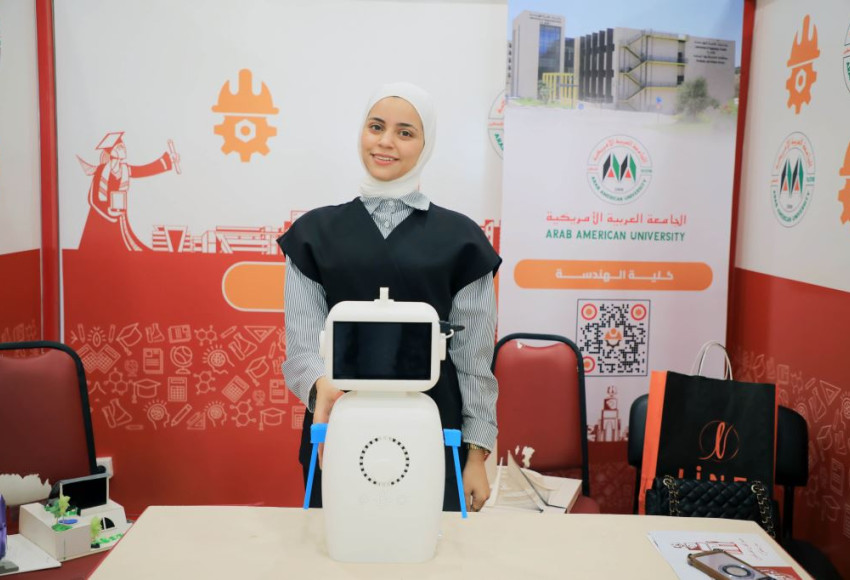
In an innovative humanitarian initiative that blends technology and social awareness, three engineering students at the Arab American University - Rafah Hoshya, Shams Freihat, and Nizam Jamal - developed a unique project entitled "Autism Interactive System." This intelligent interactive system is designed for children with autism spectrum disorder and aims to enhance their cognitive and social abilities through a fun and safe learning environment.
The idea for the project, as student Rafah Hoshya explained, stemmed from a study of the significant gap in educational resources for children with autism, particularly those in Arabic. She noted that most educational robots currently available on the global market speak English and are expensive, making them inaccessible to many families and institutions in the Arab world.
Student Shams Freihat explained that the system consists of a smart robot equipped with an interactive screen containing three main sections: an education section, which includes simplified educational activities in reading, arithmetic, and shapes; a communication section, which aims to enhance social interaction and encourage the expression of feelings and desires; and a games section, which contains stimulating games specifically designed to develop focus and visual interaction. She noted that the system is distinguished by its full support for the Arabic language, making it easy for Arab children to use and ensuring that the content is delivered in a clear and safe manner.
Student Nizam Jamal explained that the robot is equipped with a touch-sensitive light sensor that illuminates when interacted with, helping to naturally and engagingly capture the child's attention. A servo-motorized arm is also included, which interacts with the child through movement with each interaction, thus stimulating visual and motor communication. The student emphasized that the robot's design took into account the behavioral and psychological needs of children with autism, carefully selecting colors, sounds, and arm movements to be comfortable, non-disturbing, and appropriate for children with this disorder.
For his part, the Dean of the Faculty of Engineering, Dr. Mahmoud Obeid, considered the project a qualitative step towards integrating technology with remedial education, hoping that the project would receive support from private care and education institutions to develop and distribute it in schools and rehabilitation centers, stressing the importance of directing technology towards human solutions with a tangible impact, considering that working on a project that serves a marginalized segment of society is one of the highest goals of engineering education. He stated that the “Autism Interactive System” embodies the vision of the Arab American University in encouraging its students to develop innovative solutions with a social and human dimension, which elevate education and consolidate noble values in the field of engineering and technology.