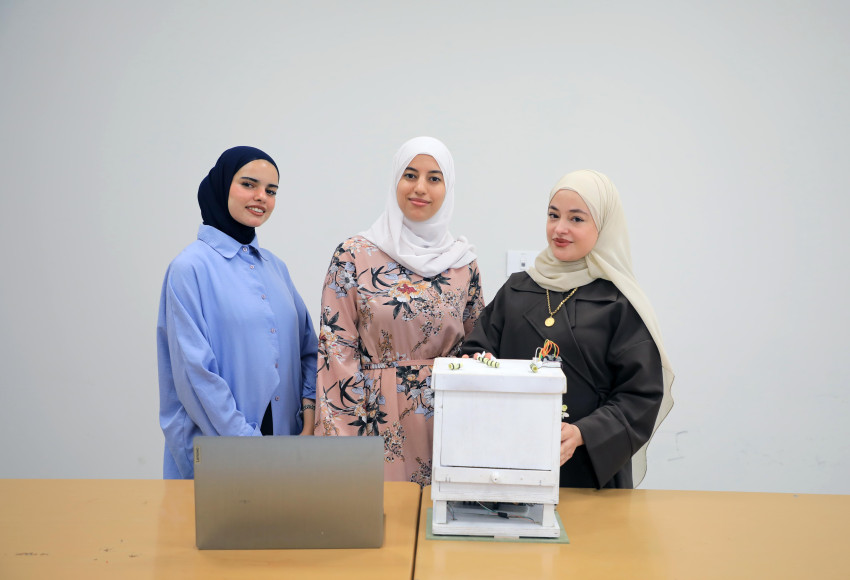
The idea for an environmental technology project with economic and social dimensions emerged from the lecture halls of the Faculty of Engineering at the Arab American University, addressing a real need in the agriculture and beekeeping sector. Students Weam Jaradat, Shaima Khader, and Aseel Abu Al-Haija decided that their graduation project would not be merely an academic application, but a step towards making a tangible impact on one of the most important sectors of agricultural production.
The idea of the project stemmed from the realization that beekeeping is no longer a traditional activity, but now requires precise technologies to monitor environmental conditions inside the hive, such as temperature, humidity, ventilation, and carbon dioxide levels - all factors that directly affect the health of the bee-colony and the quality of honey production.
Student Weam Jaradat states, "We noticed that many beekeepers suffer from problems such as swarming or the spread of diseases without detecting them in time. Therefore, we developed a system based on internal sensor units that accurately measure these factors and send data directly to a mobile application."
The smart system designed by the students also includes an electronic scale used to measure the weight of the hive, providing indicators of honey production or changes in the number of bees within the hive.
Because of this data, beekeepers would be able to make proactive decisions to address problems before they worsen, especially those related to swarming or high Varroa mite infestations, which pose a real threat to beehives.
Shaima Khader states that one of the system's main objectives is to reduce reliance on frequent manual inspections, which can be tiring or inaccurate, especially with a large number of hives or over long distances. "The system saves time and effort and gives beekeepers a greater opportunity to focus on improving production, whether they are beginners or experienced," Khader adds.
Student Aseel Abu Al-Haija pointed out that the project went beyond mere monitoring. It also included an integrated online store within the application, allowing beekeepers to purchase beekeeping supplies such as tools, treatments, and beehives, thus enhancing production sustainability and improving economic returns.
The Dean of the Faculty of Engineering, Dr. Mahmoud Obeid, expressed his great admiration for this achievement, emphasizing that this innovation represents a successful model for applying engineering knowledge to serve the community and paves the way for greater digitalization in agriculture. He stated that this project embodies the students' ability to connect scientific disciplines with the needs of the local community and sends a clear message that smart solutions are not far from reality, but can begin with a small idea and great ambition from university classrooms.