In an era of rapid technological advancement and a growing need for smart solutions to serve people in their daily lives, three engineering students from the Arab American University have developed a unique project that blends innovation with social responsibility. This project addresses one of the most prominent problems that can threaten people's lives in their homes: the dangers of unsafe cooking.
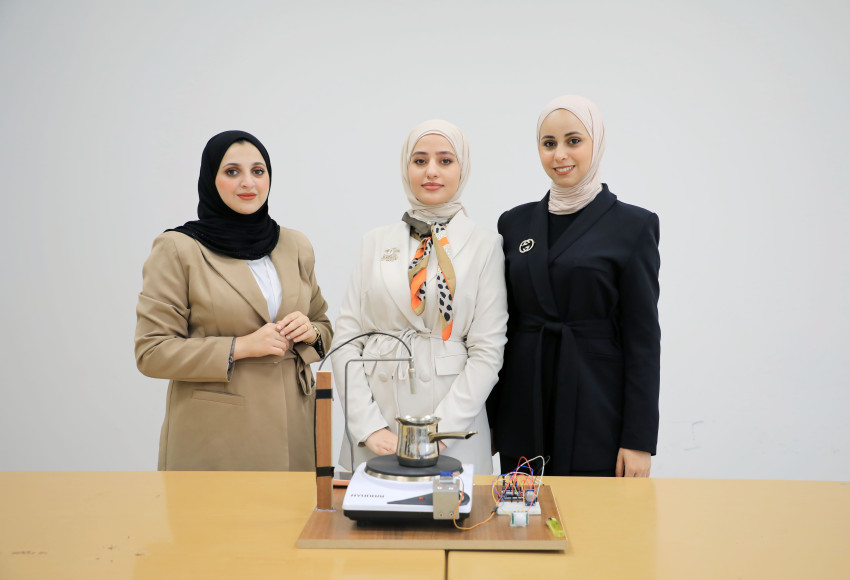
Students, Waad Hamad, Amani Maali, and Jenin Shehab, decided that their graduation project should be a practical way to make a difference. From this stemmed their idea to design a "smart system for organizing and monitoring cooking." This system relies on advanced technologies to monitor the kitchen environment, alert the user to any danger, and even take automatic action to protect them.
This system is based on an Arduino Uno R4 Wi-Fi board, a smart controller widely used in automation projects. It is connected to a set of sophisticated sensors, including a gas leak detector, heat and steam sensors, and a motion sensor to detect people near the stove.
Student Waad Hamad explains, "We thought about everyday situations that could lead to disasters, such as leaving the stove on due to a phone call or a sudden emergency. We wanted to create a system that handles these situations without requiring direct human intervention."
The system intelligently detects any danger indicators, such as gas leaks, abnormal temperature increases, or the user's absence from the stove for a certain period. When this occurs, it automatically shuts off the gas supply and sends an immediate alert to the user's phone, along with an update on the sensor status.
Through a companion smart application, the user can remotely control the stove, read the temperature, monitor sensor status, and even receive suggested recipes. This makes the system not only a safety measure but also a tool to enhance the cooking experience.
Student Amani Maali says, "Technology isn't just for innovation; it's also for protecting lives. We aimed for our project to be beneficial to every home, especially for the elderly, busy mothers, or even students in university dormitories."
Student Jenin Shehab believes this project could be a starting point for integrated smart kitchen systems. She said, "The system is scalable and can be integrated with fire systems or connected to emergency services in the future. We're not just talking about a graduation project; we're talking about the seed of a commercially and socially viable idea."
The story of Waad, Amani, and Jenin is not just an academic success story; it's a living example of how education and innovation can combine to create tools that make a real difference in people's lives.
Their project, simple in its components yet significant in its impact, proves that great solutions begin with an idea, passion, and three students who believe that technology should serve humanity.